Stock, semi-custom and custom, in a cabinet maker's own words
The three words get used loosely, and even the people who make cabinets admit it. Showplace Cabinetry, a semi-custom manufacturer, says “there are no universally accepted attributes to describe custom cabinets.” Its own site still draws the lines in a way that's useful when you're comparing quotes:
- Stock: “Standard-sized cabinets offered,” with “limited or no ability to change cabinet dimensions.” They “may be built-to-order, but often built ahead and sold from inventory.”
- Semi-custom: “Custom sizing and configurations available within standard wood species, color, and style offerings,” with cabinets “built-to-order for individual homeowner.”
- Custom: “Special configurations of cabinetry are offered without restrictions on species, color and style.”
Where semi-custom shows: the 3-inch grid and filler strips
Factory lines are built on a grid. Showplace says it builds “standard sizes in 3-inch increments with widths ranging from 9 to 48 inches, and heights of 12 to 66 inches.” A wall that doesn't land on that grid leaves a gap, and the usual fix is a filler strip: a flat panel between a cabinet and the wall, an appliance or the next cabinet.
One filler is normal and often invisible. Three in one run add up to several inches of kitchen whose only job is to look flat.
Semi-custom narrows the gap. Showplace says that in most cases it can change cabinet widths, depths and heights, with “a few exceptions, including cabinets with installed storage and organization accessories.” Notice which cabinets those are. The pull-outs and organizers people most want are the ones that are hardest to resize.
What custom gets you: the inside, the odd corner and the match
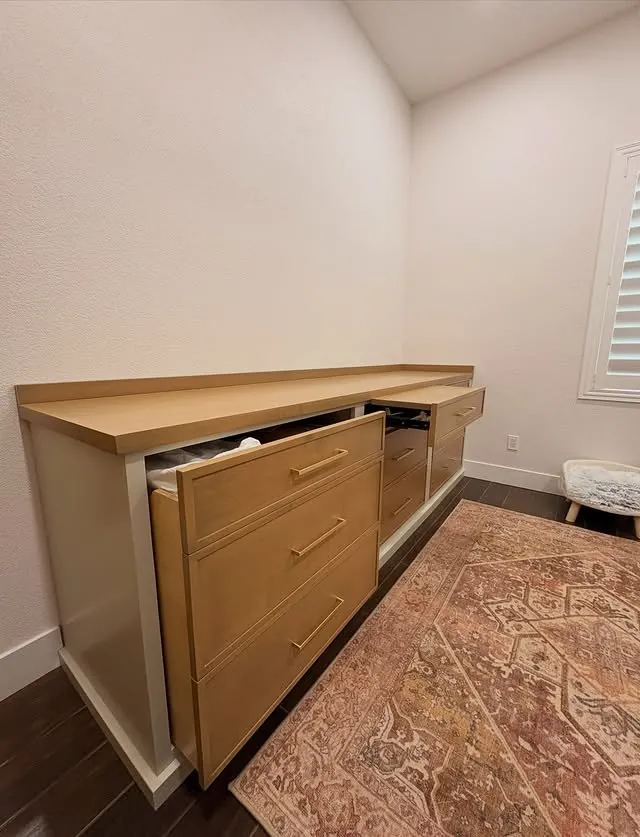
With custom work the room comes first and the boxes follow. Judy designs the inside of a cabinet before the outside, and that's where custom earns its keep. In a Henderson travel room every cabinet has a job: a steaming and wrap station, a drawer sized for suitcases, a counter extension and a sewing cabinet with a swivel top. That list doesn't map neatly onto anyone's catalog page.
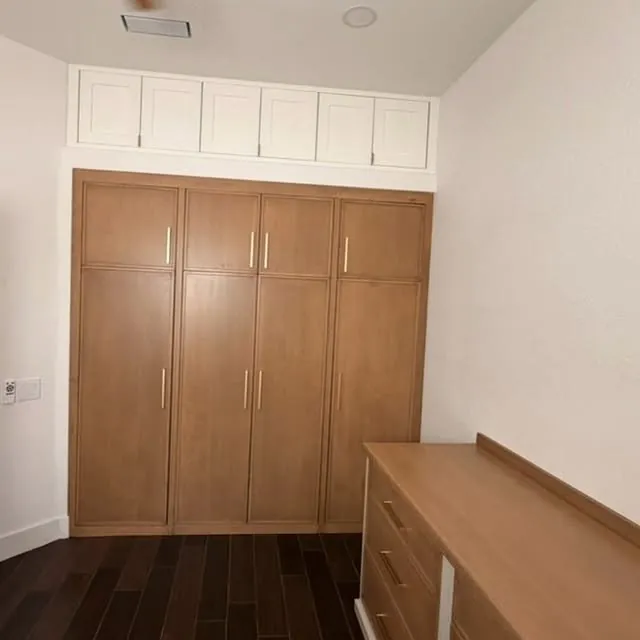
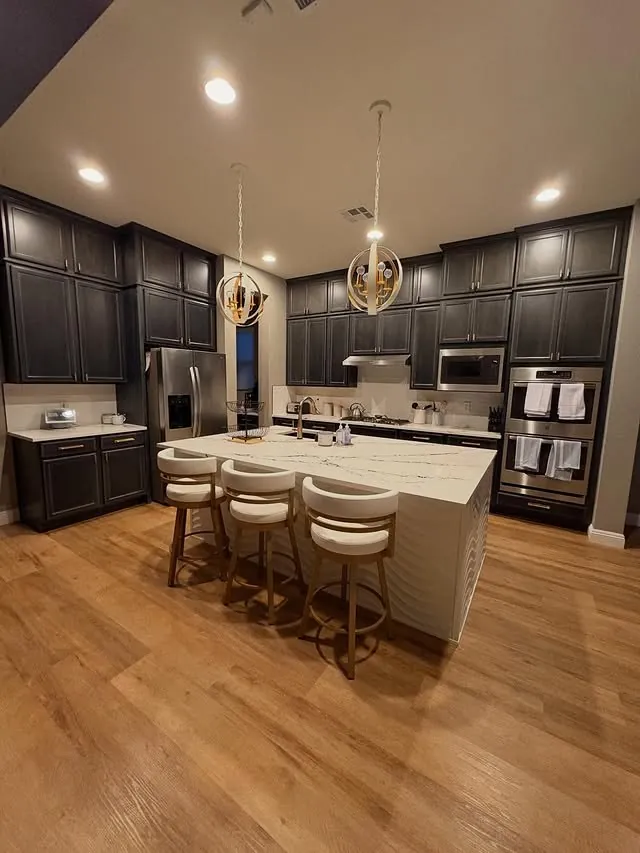
Custom also handles shapes and matches. A Las Vegas kitchen got curved panels wrapped around its island so it reads as a piece of furniture. A makeup vanity in walnut with a translucent grey stain was built to match the existing vanity in a primary bath, and it looks as if it was always there. Odd spaces count too: the empty corner under a staircase became a study with a desk and a built-in bookcase. And in a grey office, once the standard closet came out and the cabinets went to the ceiling, the safe and a set of inset cherry drawers ended up hidden behind pocket doors.
When semi-custom, or the cabinets you have, is the better call
Semi-custom suits a room that's close to the grid already: a straightforward kitchen run, finishes you're happy to choose from one manufacturer's range, and a budget you'd rather spend on counters or appliances. On price, Showplace calls stock “priced most affordably,” semi-custom “mid-priced” and custom “most expensive due to limitless options.”
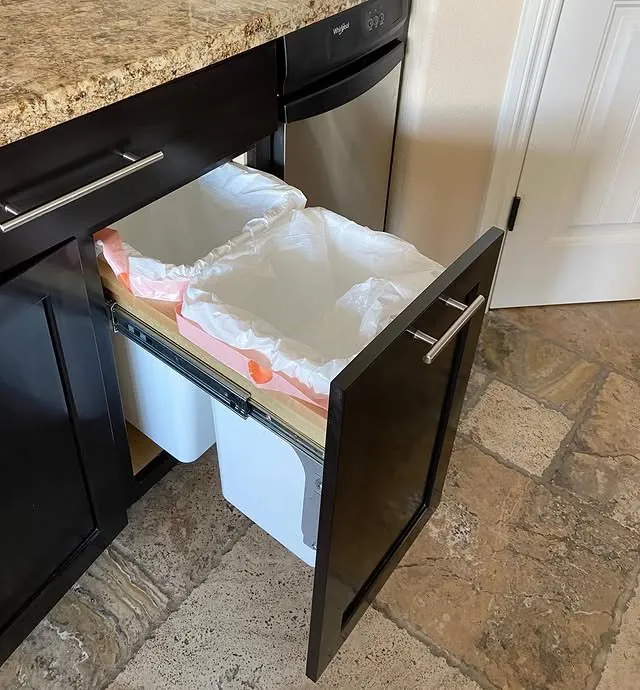
Sometimes the boxes you have are fine, and JB Custom Design adapts existing cabinets where that makes more sense. In a Seven Hills kitchen Judy kept the room and changed how it works: a trash and recycling pull-out, a pull-out for trays and cutting boards, roll-out shelves in the base cabinets, spice pull-outs, and new uppers and floating shelves in the butler's pantry.
Custom is worth a closer look when the room is awkward, the ceiling is tall or a cabinet has a specific job. In one Henderson kitchen, upper cabinets taken all the way up a 10′ ceiling, with glass and lighting at the top, turned empty wall into storage.
How to compare a custom quote with a semi-custom one
A single price for “the kitchen” hides most of the difference. Ask every quote to spell out the same things: the box sizes, how many fillers, which interior fittings are included, the door style and finish, and who installs. Ask as well when each lead time starts, because built-to-order cabinets of either kind only start once the order is in.
JB Custom Design doesn't publish set prices, because every room is different. After the in-home meeting and design, you get an itemized scope with material and labor broken out on every line, so you can see exactly what the custom parts cost and decide which ones are worth it.
What to do this week
Measure your longest cabinet wall and see what's left over when you split it into 3-inch steps. Whatever is left is roughly where the fillers would go (corners and appliances complicate it, but it's a start). Then write down what your current cabinets do worst.
When you're ready, book a consultation. Judy comes to your home for a 90-minute meeting about style, budget and time frame, and you see the options in creative visuals before anything is built.
Rules change and differ by jurisdiction. This guide is general information, not legal advice: confirm with your building department and the Nevada State Contractors Board for your project.